Expanded Polystyrene (EPS) is widely used in construction, packaging, and insulation due to its lightweight structure and versatility. One of the most important (and often misunderstood) properties of EPS is its strength. While EPS may appear fragile, it can provide significant load-bearing capacity when properly specified and installed.
This article explains EPS strength, how it’s measured, what affects it, and how strong EPS really is in real-world applications.
What Does “EPS Strength” Mean?
When people talk about EPS strength, they are almost always referring to compressive strength — the material’s ability to resist loads pushing down on it. In practical terms, this means how well EPS can support weight without flattening or losing its insulating properties.
Compressive strength is measured by applying increasing pressure to the material until it compresses by 10% of its original thickness. This point is used as an industry benchmark because it represents a meaningful level of deformation without indicating material failure.
Although EPS is not a structural material, it plays a critical supporting role in many building assemblies. When placed beneath concrete slabs, roofs, or foundations, EPS helps distribute loads evenly, reduce stress on structural elements, and prevent settlement over time.

EPS Compressive Strength Ratings
EPS is produced in multiple density-based grades, with increasing density resulting in higher compressive strength and greater load resistance.
Standard EPS Strength Classes (U.S.)
| EPS Type | Minimum Compressive Strength | Typical Density | Common Uses |
| Type I | 10 psi | ~1.0 pcf | Wall cavities, light-duty insulation |
| Type VIII | 13 psi | ~1.25 pcf | Exterior walls, below-grade walls |
| Type II | 15 psi | ~1.5 pcf | Under slabs, residential foundations |
| Type IX | 25 psi | ~2.0 pcf | Commercial floors, roofs |
| Type XIV | 40 psi | ~2.5-3.0 pcf | Industrial floors |
| Type XV | 60 psi | 3.0+ pcf | Heavy-load applications |
Important:
The listed values represent minimum compressive strength at 10% deformation, which is a standardized test point — not a recommended working load.
In real-world design, EPS is used at significantly lower stress levels to ensure long-term performance. As a general engineering guideline, working loads are typically limited to 20-30% of the rated compressive strength to minimize long-term creep and maintain dimensional stability over time.
EPS Strength in Metric Terms
EPS compressive strength is also commonly expressed in kilopascals (kPa), particularly outside the U.S. The table below shows how common metric EPS grades align with typical compressive strength values.
| EPS Grade | Approx. Compressive Strength |
| EPS 70 | ~70 kPa (10 psi) |
| EPS 100 | ~100 kPa (15 psi) |
| EPS 150 | ~150 kPa (22 psi) |
| EPS 200 | ~200 kPa (29 psi) |
As with psi ratings, higher-density EPS corresponds to higher compressive strength.
What Affects EPS Strength?
EPS load performance depends on several key factors that must be considered during specification and design, including:
Density
Density is the single most important factor affecting EPS strength. As density increases, the polystyrene bead structure becomes tighter and more rigid, allowing the material to resist higher compressive loads.
Lower-density EPS is softer and more flexible, making it suitable for light-duty insulation, while higher-density EPS is designed for applications where load support is required.
Load Duration
EPS performs especially well under static, long-term loads, which are common in construction. However, like most foam materials, EPS can experience gradual deformation when subjected to constant pressure over extended periods.
To prevent this, working loads are typically kept well below the 10% compression rating. When properly designed, EPS maintains its thickness and strength for decades without noticeable compression.
Temperature
EPS retains its compressive strength across a wide range of building temperatures. It performs reliably in cold climates and maintains stability under moderate heat, making it suitable for both interior and exterior applications.
Extreme temperatures can affect any insulation material, but EPS remains dimensionally stable under normal building conditions.
Moisture Exposure
EPS has a closed-cell structure that limits water absorption. Even when exposed to moisture, it retains most of its compressive strength and insulating performance. This makes EPS well suited for below-grade, under-slab, and other moisture-prone environments where strength retention is critical.
EPS Strength vs. XPS Strength
EPS is often compared to extruded polystyrene (XPS) because both materials are used in similar insulation applications. While XPS may offer slightly higher initial compressive strength at the same thickness, EPS provides several important advantages in real-world conditions.
When properly specified, high-density EPS performs just as well as XPS in many load-bearing insulation applications, particularly where long-term stability and moisture exposure are concerns.
Real-World Applications Where EPS Strength Matters
EPS is strong enough for a wide range of demanding applications where insulation and load distribution are both required.
Common applications include:
- Under concrete slabs, where EPS supports the weight of the slab and building loads while helping prevent heat loss and uneven settlement
- Foundation perimeter insulation, where EPS must resist soil pressure while maintaining thermal performance below grade
- Roof insulation beneath ballast systems, where it supports gravel or pavers without excessive compression
- Road and bridge embankments, where large EPS geofoam blocks reduce soil loads and improve ground stability
- Structural insulated panels (SIPs), where EPS acts as the core material that distributes loads between structural facings
In all of these uses, EPS does not replace structural materials such as concrete, steel, or wood. Instead, it supports them by spreading loads evenly and maintaining consistent insulation performance.
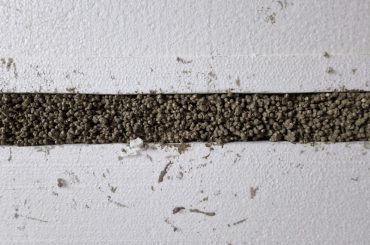
In addition to factory-formed insulation panels, EPS is also commonly used in the form of EPS beads, which are mixed with cement to create lightweight insulating screeds and fills. While EPS bead insulation is not designed for structural load-bearing, it still benefits from the same material properties — low weight, thermal insulation, and controlled compressibility.
To learn more about how EPS beads are used in floors, screeds, and lightweight fills, see our detailed guide on EPS bead insulation.
Is EPS Strong Enough for Your Project?
EPS is more than capable of meeting most insulation and load-distribution needs when it is properly specified and installed. Successful performance depends on a few key factors:
- Selecting the correct density or grade for the expected loads
- Designing conservatively to account for long-term performance
- Following manufacturer recommendations and installation best practices
As a general guideline, lighter-duty insulation applications typically use lower-density EPS, while slabs, foundations, and roofs benefit from higher-density grades designed for sustained loads.
For both residential and commercial construction, EPS offers an excellent balance of strength, durability, and cost efficiency, making it a dependable choice for many applications.
When properly specified and installed, EPS delivers predictable strength, long-term dimensional stability, and cost efficiency. Rather than being a compromise material, EPS functions as an engineered load-distribution layer that supports structural systems while maintaining consistent thermal performance over time.
You may also like: How to Cut EPS Foam Insulation