When there isn’t enough height for a thick layer of traditional insulation plus a concrete screed, a mix of EPS beads and cement can be used to create a lightweight, insulating fill. This material is often called EPS concrete, polystyrene concrete, or insulating screed.
Instead of solid stone aggregate, the mix uses expanded polystyrene (EPS) beads. The result is much lighter than normal concrete and provides useful thermal insulation, making it ideal for floor build-ups, void filling, and renovation projects where every inch of height matters.
What Is EPS–Cement Mix?
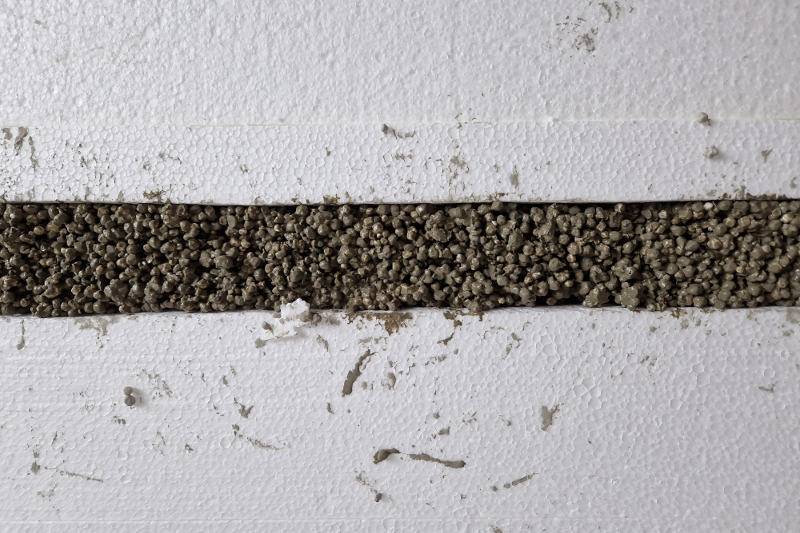
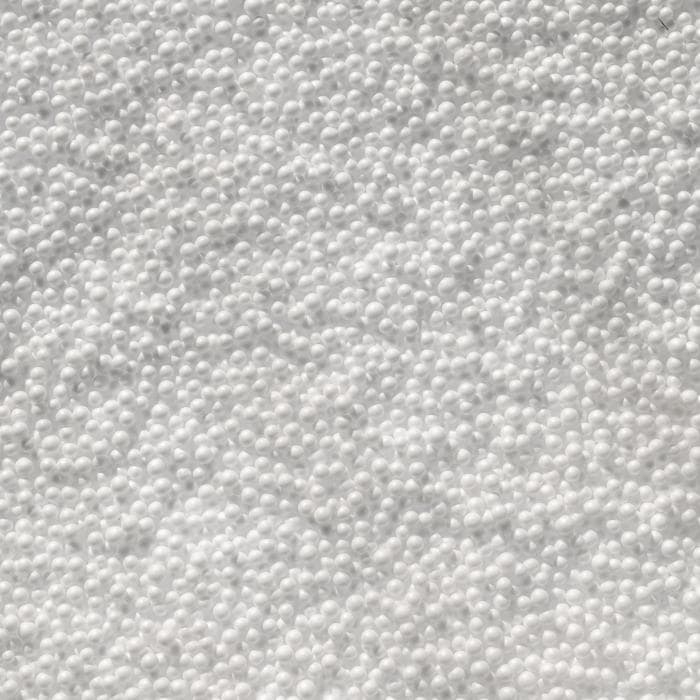
EPS–cement mix is made by combining loose EPS beads with cement and water, sometimes with a little sand or additives to improve workability. The cement doesn’t form a dense solid like normal concrete. Instead, it lightly coats and binds the beads together, creating a rigid but very lightweight material full of trapped air.
Because the “aggregate” is foam rather than stone, its properties are very different from standard concrete. It is much lighter, has lower compressive strength, and provides noticeably better thermal insulation.
It is not structural concrete, so you shouldn’t use it to replace a load-bearing slab. Instead, it can act as an insulating and levelling layer that is usually covered with a thin traditional screed or other floor finish layer that takes the loads.
Where It’s Used
EPS–cement screed is most useful where you need to add insulation and build up levels but cannot afford the weight or thickness of conventional concrete plus insulation.
Typical applications include:
- filling large, deep cavities around cables, pipes, and ducts
- renovating older buildings where ceiling height is limited
- replacing heavy rubble or concrete infill in timber or fragile floors
- correcting badly uneven existing slabs while improving thermal performance
- forming gentle slopes (falls) toward drains
Because the mix is fluid when placed, it’s easy to spread around obstacles and fully fills irregular voids that would be difficult to pack tightly with rigid boards or blocks.
Once cured, it becomes self-supporting and stable, so in non-load-bearing situations it can replace thick layers of compacted hardcore or plain concrete that would otherwise add unnecessary weight.
This makes it especially valuable in refurbishment work, where the structure already exists and the goal is to improve insulation and levels without overloading the building or sacrificing precious headroom.
Typical Floor Build-Up
- Existing structural slab or deck
- EPS–cement insulating layer (variable thickness)
- Thin levelling or wearing screed
- Final floor finish (tiles, wood, vinyl, etc.)
Key Advantages
Here are the four main advantages of EPS–cement compared to using standard concrete or insulation boards on their own.
Lightweight
It can be several times lighter than standard concrete, which reduces the load on existing structures and makes it suitable for older or weaker floors.
Insulating
The trapped air in the EPS beads reduces heat loss and sound transmission through the floor, often removing the need for a separate thick insulation board.
Adjustable Thickness
It can be poured from about an inch to many inches thick without excessive weight, so it works equally well for shallow levelling layers and deep void filling.
Easy to Place Around Obstacles
Because it is poured, the mix flows around pipes, ducts, and cables and fills irregular spaces without complex cutting or fitting.
Important Limitations
EPS–cement also has some limitations. Most importantly, it is not a finished wearing surface and is not designed to carry heavy point loads on its own.
In most cases it must be covered with a load-distributing layer such as a thin traditional sand–cement screed, a fibre-reinforced screed, or structural floor boards and panels.
It also does not replace a structural concrete slab. It can fill space and add insulation, but any structural loads must still be carried by the existing slab or beams below.
Mixing and Installation Basics
The EPS beads need to be evenly coated with cement paste while staying intact. The goal is to glue the beads together, not crush them.
A typical mix is about 1 part cement to 8 parts EPS beads by volume, with just enough water to form a wet slurry that coats every bead. This ratio can be adjusted depending on what you need from the layer.
For example, adding more cement makes the mix stronger and harder but also heavier and less insulating. Adding more beads makes it lighter and better insulated, but weaker. In practice, mixes around 1:6 (cement:beads) are used where higher strength is needed, while mixes around 1:10 are used where low weight and better insulation are more important.
If too much water is added, the mix becomes weak and can shrink as it dries. If too little water is used, the mix is dry and difficult to spread, and the beads won’t bond properly.
For that reason, hand mixing in a standard drum mixer is often unreliable. In practice, good results are achieved with:
- forced-action mixers or screed pumps that gently fold the mix together
- pre-bagged proprietary mixes where the correct bead-to-cement ratio is already set
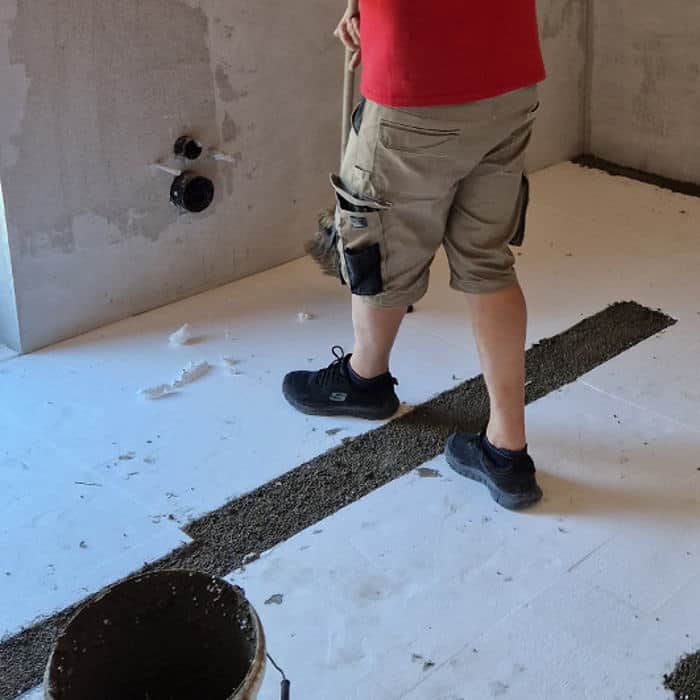
Once mixed, the material is poured into place and roughly levelled with a rake or straightedge. It is then lightly compacted or tamped just enough to remove large voids.
It should not be vibrated like normal concrete, because vibration makes the lightweight beads rise and the heavier cement paste sink, causing separation and weak spots.
After placing, the surface is left to cure like any cement-based screed. Depending on thickness and conditions, this usually takes at least a few days before applying the top screed or floor layer, and longer before heavy loading.
When to Choose EPS–Cement Instead of Boards
| Situation or Priority | Better Choice |
| You need levelling and insulation in one layer | EPS–cement mix |
| Available floor height is very limited but build-up must fill deep voids | EPS–cement mix |
| Substrate is uneven or crowded with pipes and cables | EPS–cement mix |
| Reducing structural load and weight is critical | EPS–cement mix |
| You need higher compressive strength directly under the finish | Rigid insulation boards |
| The base slab is already flat and level | Rigid insulation boards |
| You want maximum insulation value in the minimum possible thickness | Rigid insulation boards |
In Summary
EPS beads mixed with cement create a lightweight, insulating floor fill that replaces heavy concrete or thick board build-ups where space and weight are restricted. It won’t carry structural loads on its own, but as part of a layered floor system it provides an efficient way to level, insulate, and prepare floors for a final screed and finish.
Be sure to check out our related articles, for example on EPS insulation strength or EPS vs XPS. If you have any questions or want to share your experience, leave a comment below.