Doorknobs can sometimes get stuck due to changes in humidity, temperature, or general wear and tear. While these issues might resolve themselves as conditions shift, they can also persist and require attention. Fortunately, you don’t need to hire a professional or spend a lot of money to fix a stuck doorknob.
This article provides practical tips for troubleshooting and fixing a doorknob that won’t turn. From simple solutions like jiggling the knob to loosen stuck components, applying the right lubricants, or inspecting the assembly, these steps are easy to follow and cost-effective.
Many homeowners have successfully used these techniques to resolve doorknob issues. By following the guidance in this article, you’ll likely be able to solve the problem quickly and efficiently.
1. Jiggle the Door Knob and Lubricate
Occasionally the problem could be a minor issue that can be solved by just jiggling the doorknob to get the stuck part loose. This trick works mostly in situations where the springs are not correctly in place, or the latch fails to extend or retract.
As you jiggle the doorknob, try to gently hold it so that you don’t worsen the problem. Note that if the problem is complex, you could make it worse if you jiggle vigorously and carelessly. You need to do it gently so that you don’t break the doorknob.
Find the right lubricant like graphite and squirt a couple of drops on your doorknob. Try to turn the knob a few times so that it spreads evenly. After lubricating, carefully inspect the mechanism on both knobs to see if there is any rust. Add more drops of the lubricant to loosen any stuck part.
2. Check the Latch and Doorknob Assembly
Carefully inspect the latch. If it is retracted, but the doorknob does not turn, it might imply that it is misaligned or caught in something.
To fix the problem, you need to use a flat screwdriver by placing it right above the latch and tap it gently using a hammer. Repeat the process on the underside of the latch. It should be freed if it was caught on something.
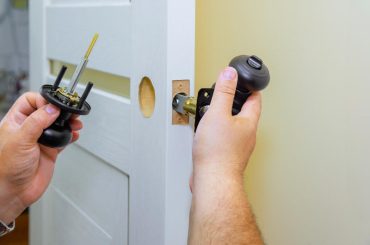
If you don’t see any problem with the latch, try to check the doorknob assembly. Do this by removing all the screws from the plate and uninstall the doorknob from the door. Carefully check inside the doorknob if there is any problem with the mechanism.
In case of an obstruction, use needle-nose pliers to remove them. You might have to replace the doorknob if the mechanism has a major problem, like broken components.
3. Check the Plates
Once you have removed the door handles, you can check the plates if there are any issues. Operate it, and you may identify any visible signs of malfunction. There are springs on the rear part of each handle. Check to confirm that the springs are not bent or broken.
If the springs are in the right condition, they need to get back to a horizontal position when you stop moving the handles. However, if they are broken, you might have to replace them. Before you do any replacement, apply some lubricant such as WD40 on the door handle and see if it works.
4. Check the Tubular Latch
This should be your next step if the doorknobs are okay, and there is no problem with the springs. Remove the latch from the door. It is a simple step that only involves removing the screws from the faceplate on the leading edge of the door.
Once that is done, the tubular latch will slide out from the door. You can identify the issue by pushing in the latch bolt tongue and see if it springs back.
5. Check the Latch Body
By checking the latch body, you can identify any signs of malfunction or wear. Look for things such as components poking out or loose springs. If you have not seen any problem, push the latch tongue again and see if it returns back to place. If it does not spring back, then it could be a broken spring inside the latch.
When pushing in the latch tongue, take it into the latch housing. If it goes in, but the tongue is still poking out, it is an indication of a broken spring in the latch that needs fixing. You may need to replace it entirely if most components are broken on the inside.
6. Check the Rotating Lugs
If your latch seems to be working fine after troubleshooting, there is one more problem to check. Your tabular latch should have two lugs on either side where the spindle goes through. These lugs ensure that the follower operates correctly. There are chances that the lugs are blocked with an object and need fixing.
If the borehole is too small when the tubular latch was installed, it could obstruct lugs. If that is the case, then you need to bore a wider hole on the door. Typically, this scenario leads to broken springs and other latch components, so you may need to replace the tubular latch.
7. Re-Attach the Knob
Once you have fixed the problem, you need to re-attach the knob. While doing this, you must ensure that the center shaft of the knob easily inserts through the hole in the latch mechanism. Confirm that the threaded sleeves are fitted into the two center holes on the latch mechanism.
Insert the door handle on one side of the door. The retaining screws should be thread through the mounting holes on the faceplate of the interior doorknob. Ensure that it runs into the sleeves of the exterior doorknob. Use a screwdriver to tighten the screws, and you are good to go.
8. Make Adjustments
Make adjustments, turn the doorknob, let the latch bolt retract into the door, and hold it in position for a moment. Use a graphite lubricant around the interior edge of the latch bolt. Turn the doorknob several times so that the lubricant is evenly distributed, and use a rag to wipe off any excess lubricant on the surface.
The strike plate should be adjusted up or down as necessary. If you feel that you need to replace your handle, you may have to buy another.
A doorknob uses a spring-loaded latch to function correctly. The spring extends fully when the lock is at rest. The spring should compress when you turn the knob and open the lock allowing you to open the door.
If you’ve assembled everything and the knob is turning but can’t open the lock, it’s an indication that the latch, spring, or both have a problem. The knob is not correctly interacting with the latch, spring, or both and makes it spin without opening.
The cause of such a problem could be the different connections in your door lock. You will have to repeat the process and test every moving part to ensure it’s properly aligned, and the retraction mechanism is working correctly.
Last Thoughts
There are many causes of a doorknob failing to turn. If they have remained idle for several weeks or months, they could rust from inside. When this happens, they won’t turn and need fixing.
Before you start correcting, you need to find where the problem lies. A graphite lubricant and slight jiggling could solve the problem.
Most homeowners tend to replace stuck doorknobs before they know where the problem is. However, you can avoid such unnecessary expenses if the problem is minor and only takes a few minutes to fix.
We hope that this article helps you fix your doorknob. If you need to replace some components of your doorknob, you may have to visit the nearest store or order online.